
BRITE Institute's early warning system and failure intelligence technology stack monitors real-world AI failures, uncovers their root causes, and delivers solutions to the people who can fix them.
DONATEMost AI are evaluated before launch, in controlled studies with carefully selected data.
Once deployed, these AI operate inside complex systems such as hospitals. They must interact with overworked staff, real patients, shifting workflows, and vague policies.
It is in this post-deployment enviroment where many AI problems first appear - and where few systems exist to catch them.
The majority of sepsis cases were missed by a widely used hospital sepsis prediction model
Well over 245,000 people die each year in the USA alone due to preventable medical error.
Only 44% of hospitals evaluated their AI models for bias, and even then, not necessarily continuously
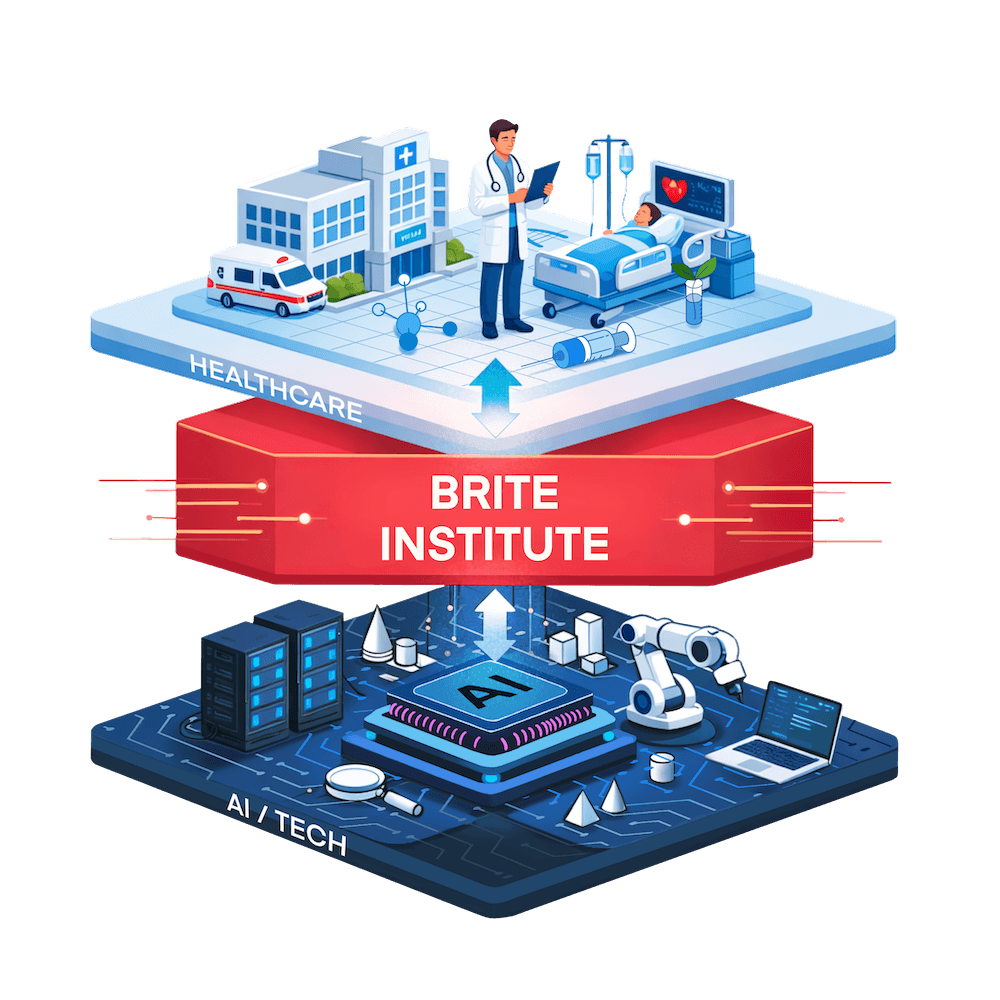
AI failures in safety-critical settings can go unnoticed until someone is harmed.
BRITE Institute’s early-warning system turns firsthand reports of AI failures and near misses into actionable intelligence.
We share that intelligence with hospitals, AI developers, and policymakers so they can understand emerging risks and act before harm occurs.
No concern is too small. A strange output, a near miss, or a pattern you’ve noticed may be the early warning that prevents serious harm.
You are invited to report your experiences via our secure, anonymous form. Click to create a case.
BRITE Institute’s failure intelligence system collects real-world reports, identifies recurring failure modes, determines root causes, tests the extent and scope of AI risks, and alerts the people who can act before harm spreads.

Below are just a few of the many AI safety risks BRITE Institute's system is able to monitor in real time.

Many AI tools rely on a human in the loop, but this check can be poorly managed, unclear, or ineffective.

An AI system’s behavior can shift away from its intended purpose over time, often after software updates.
AI exposes, retains, or uses sensitive personal information in ways people did not expect or consent to.
AI can perform worse for certain groups based on race, sex, age, language, or other factors.

AI accuracy can change over time. Because drift happens slowly, it often goes unnoticed until errors accumulate.
AI can make work harder and cause interruptions that slow people down and undermine safe, efficient work.

AI acts in ways that people can no longer reliably monitor, correct, or stop.
AI develops or demonstrates abilities that could cause serious harm if misused or left unchecked.

AI produces or spreads inaccurate or misleading information that people may trust and act on.
Our work is backed by years of research, both original and secondary. We continue to conduct cutting edge research to further AI safety and improve our own offerings. Below is a selection of some of our past and current research projects.

Human oversight is the safeguard of last resort for AI, and from late 2026 became a legal requirement for high-risk systems under the EU AI Act. Our research examines whether that safeguard actually works.

Medical LLMs are often trained and evaluated using clean, well-organized patient records. Unfortunately, real patient records can have significant missing data - exceeding 30% missingness in some cases. What problems does this create for patients safety?

Over ten months, BRITE Institute applied failure mode and effects analysis to more than 700 documented cases in which people were harmed by AI systems between 2018 and 2025.
Donating to patient safety is one of the highest-impact ways to save lives, as preventable harm in healthcare remains widespread. Strategic investment can help healthcare teams stop errors before patients are hurt.
Your donation may even end up saving your life or the life of a loved one.
Below are some frequent questions we get asked. If you have a question and don't see the answer below, feel free to ask via our contact page.
BRITE Institute is a research and development nonprofit organization dedicated to ensuring AI improves patient care and safety - and that AI does not endanger patient safety. We conduct both basic and applied research, work with industry, and develop tools to improve the design and implimentation of AI in heatlhcare.
Yes, BRITE Institute is proud to be recognized as a 501(c)(3) nonprofit organization. All donations to BRITE Institute are tax deductible.
Our research includes basic studies for understanding complex system risks and applied studies for developing effective risk management technologies. You can see our current research here.
As a public charity, we believe we need to go above and beyond to earn and keep your trust. We have adopted a four pillar framework which goes far above and beyond what is required by law. Our four pillars of integrity are: independent audits, transparency, expert oversight, and compliance. These pillars guide our operations and are central to maintaining the highest standards of integrity and effectiveness in our work. You can read more about our governance here.
Donations are vital to our mission and operations. To support us financially, you can visit our website's donation page. Your contribution is greatly appreciated, and we take our responsibility to spend funds wisely seriously!
There are many ways to support the BRITE Institute including volunteering, supporting our social media, and more. Visit our support page to learn more!
We welcome your queries and interest. You can reach out to us via email at info@briteinstitute.org or through our website's contact page.
BRITE Institute's headquarters is in Arizona, but we are a remote team with team members across the USA and the world.